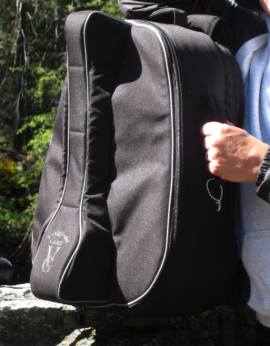
Here you will find what Industry media outlets are saying about the Voyage Air – a real guitar that folds in half!

Note: Mixdown Magazine is noted for its gear reviews in Australia.  Here’s their first look at the Voyage-Air VAD-1 Dreadnought guitar:

Voyage-Air Acoustic Travel Guitar

Alright, I cannot repeat what actually came out of my mouth when our Editor first showed me this new guitar, but let’s just say it was a combination of disbelief and amazement. Every now and then, a new product comes along that defies explanation and makes us wonder why it hadn’t been done before. Then you stop and think, how on earth did they manage to do that in the first place? The Voyage-Air acoustic guitar is just that. The ultimate traveling guitar, it folds up and fits snugly into a specially designed backpack style case for easy transport. Yes, you heard me right – it folds up!


Carry-On Luggage

Anyone who has ever traveled with their guitar on an airplane knows the fear of letting it go into the hands of the baggage handlers to maybe never return in its original state. Now, the worries can be gone as with the Voyage-Air guitar you can take it on board with you in carry-on luggage. The folding design of the Voyage-Air guitar seems slightly farfetched to begin with, but it really works. This is a full bodied, solid top acoustic guitar. Not short scale, not slimline, not any other compromise. You get it all, and you get it in a small case, folded in two! I had the VAD-1 model to road test, this is an all solid guitar, spruce top and mahogany back and sides, with a gloss body and satin finish on the neck. When assembled it looks not unlike any other acoustic guitar of similar specifications, but when it is folded in half it looks like some other beast altogether. There is a split in the neck just below the fourteenth fret, where the neck joins the body allowing the strap pin to be unscrewed so the neck can be folded in.

Back in Tune

So, I immediately thought of all sorts of problems that could go wrong with this guitar and tuning stability first came to mind. But clicking the neck into place and tightening the screw saw the guitar sit right back in tune as though it was always in one piece. A clever string through design in the nut, with a zero fret just beyond that stops the strings from coming loose from the capstans when the pressure is relieved from the neck. This clever idea really took my fancy as it is something so simple, yet so clever and without it, it could be a make or break design point. I was also a little concerned about the playability, as you usually expect your guitar’s neck to be firmly joined into the body and not be able to move. The action was slightly high, but this was only due to saddle height and could easily be adjusted by a guitar tech to bring it down. As far as the curve of the neck and the action were concerned, it was pretty much spot on. I wouldn’t have thought it would work, just looking at the guitar to begin with, but it all comes together nicely. Tonally, the VAD-1 is a warm sounding instrument, almost with a classical nylon string tone to it, benefiting from the all solid construction. It feels great, sounds great, and packs up to go anywhere on your back. I think, as you all read this, disbelief will be quite popular. So, all I can say is, go and try one out. I was amazed. You will be too.

By Rob Gee

RRP:
Dis­trib­u­tor: Sonic Frog
Phone: (08) 8354 1115
Web­site: www.sonicfrog.com.au

The Voyage-Air Guitar
by Dan Miller –

Over the last couple of decades many guitar companies have come up with a variety of different “travel guitars.” The problem with most of them is that in order to make them more compact for travel, these guitars have been smaller in size than standard size guitars. The smaller size made them easier to throw in the overhead bin of the airplane, or the trunk of the car, and made them easier to carry long distances. However, the smaller size did not make them easier to play. In fact, some of them were quite difficult to play. Because of the different size, you had to make adjustment to the way that you held the guitar, played the guitar, and attacked the strings. I’ve always seen this as the main drawback to travel guitars.

The other problem with the various travel guitars that I’ve seen is that the quality of the sound was far inferior to standard guitars. They may have sounded OK sitting around the hotel room practicing by yourself, however, in a jam session the sound was seriously lacking, and forget about trying to play them in a show. If you had to play in a jam or a show, you were going to have to lug your full size guitar with you. So, although the small travel guitars may serve to keep your fingers nimble when you were traveling somewhere that was near impossible to lug your full size guitar, their utility beyond that is questionable. They are all shallow replacements and their only saving grace was that they were easier to carry around.

With the invention of their full-size folding guitar, I believe that the Voyage-Air guitar company has solved all of these travel guitar problems. I have had my Voyage-Air guitar for exactly a year now and I have taken it with me to 43 states and 6 foreign countries. I’ve had it on planes, trains, boats, cabs, ferries, cars, bicycles, recreational vehicles, and buses. I have practiced with it in hotel rooms, I have taught workshops with it, I have used it in jam sessions, and I have performed with it on stage. It has been extremely easy to carry everywhere I have taken it and when I’ve played it in a jam, in a workshop, or on stage, I don’t feel like I was playing a sub-standard guitar. It held its own in all situations. To me, it is not a travel guitar that sounds great. It is a great sounding guitar that makes traveling easy.

I waited a full year to write the review of the Voyage-Air guitar because I wanted to have the chance to travel with it extensively, use it often, and put the hinge mechanism through the test of time. After dozens and dozens of repetitions of opening and closing the hinge and folding and unfolding the neck in a wide variety of climates, the highly precise and expertly designed hinge mechanism that allows the neck to fold in half and then rejoin the body with an extremely accurate fit, has never wavered in tolerance. The neck rejoins the body’s neck block so accurately that it is very difficult for a casual observer to even tell that there is a seem. One would have to look very closely to see that this is not a standard guitar.

I have been impressed with every aspect of the Voyage-Air guitar design and the travel backpack that comes with it. Not only is the hinge mechanism precise, but also when the neck folds, the strings don’t fly all over the place because they are threaded through holes in the specially designed nut. The Voyage-Air also includes a zero fret and a compensated bridge. When you unfold the neck you only need make minor adjustments to the tuning to get all of the strings back in tune. The folding and unfolding process is accomplished in less than a minute. From the time you take the guitar out off of your back to the time you are in tune and ready to play is only a matter of a couple of minutes, maximum.

The guitar fits very snuggly into the back pack and is well protected when inside. The backpack comes in two parts, however the two-part case only comes with the Premier Series guitars, and the Transit and Songwriter Series have the laptop storage accessory integrated into a one-piece unit. My Premier case can be separated and rejoined with a zipper. Each of the two parts has backpack straps. The first compartment holds the guitar and also has a zip pocket that can hold picks, extra strings, tuner, etc. The second backpack compartment can hold books, laptop, sheet music, and such larger items. When the two backpack pieces are together, the backpack can fit in the overhead bin of most aircraft. When I’ve traveled on smaller planes, with smaller overhead bins, I have simply unzipped the two pieces of the backpack and stored them next to each other in the overhead bin. I love the backpack design as much as I love the guitar.

Voyage-Air makes a number of different acoustic guitar models, which can each be categorized at three different price points. At the least expensive price point is the transit series. This series retails for around $500 and are all made of laminate woods. Both back and sides are laminated. The mid-range price point models, the songwriter series, feature laminated back and sides, but a solid wood top. These models retail for around under a $1000. The top of the line Voyage-Air guitars, the premier series, are all solid wood and retail for around $1500-$2000. My Voyage-Air is one of the premier models and features mahogany back and sides. I think that the guitar plays as well and sounds as good as any of the new mahogany guitars on the market today that can be found in the $2000 to $3000 price range.

When I have played the guitar at workshops, at jam sessions, or in shows, people have commented that they cannot believe how good it sounds. My musical partner Tim May likes the guitar so much that he borrowed it from me in order to take it on a two week bluegrass tour of Russia. Tim, an instrument repairman and builder, is pretty picky about what he plays on stage. The fact that he felt this guitar sounded good enough and was set up well enough for him to use on tour with an all-star bluegrass band (which includes Bill Evans on banjo, Barbara Lamb on fiddle, and Todd Phillips on bass) touring in Russia says a lot about the guitar’s quality.

The man behind the design of the Patented Voyage-Air hinge mechanism is Harvey Leach. He eventually teamed up with entrepreneur /investor Jeff Cohen, Michael Ferrucci (sales and marketing), and Adrian Bagale (manufacturing and operations). The guitar was first introduced in 2008. Michael Ferrucci, who owned a high-end guitar store for years, said that their first goal was to take the guitars to boutique guitar stores and see if they could pass the “credibility test.” This was a tall order since the owners of boutique stores tend to be very particular.

Michael said, “We knew that traditionalists would be skeptical and that a folding guitar may not have been viewed as legitimate. We wanted it to be a premier instrument that could be taken anywhere.” The team worked very hard to produce an instrument that wasn’t going to be simply viewed as a novelty travel guitar. Their goal was to be viewed, and used, as a real guitar that could be played on stage alongside any other guitar. There is currently a very impressive list of players who have used the Voyage-Air guitar one stage, so I’d say they have met their goal.

Over the past couple of years Voyage-Air has received photos from owners who have played the guitar in helicopters, at the North Pole, in the jungles of Brazil, and in the Gobi Desert. In the summer of 2012 I took a trip to the Yucatan Peninsula in Mexico and, as a test of the Voyage-Air’s portability, I decided to take my guitar along with me. In order to get there I flew from California to Florida, took a taxi from the airport in Ft. Lauderdale to a cruise ship port, and then took the cruise ship to Cozumel, Mexico. From the dock in Cozumel I took a taxi to the ferry landing, took a ferry to the mainland, took another taxi to the town of Tulum, and then walked about a mile to reach the ruins. Once there, I took off my backpack, unfolded my guitar and played a tune. With the Voyage-Air, there was no hardship in getting a guitar to that remote destination. It was like traveling with any other lightweight backpack.

In the beginning Harvey was manufacturing the guitars one at a time by hand. Eventually, with the help of Adrian Bagale, who had experience working with acoustic instrument manufacturing facilities in China, the company hooked up with the top factory in China. The guitars and tooling are designed in California. The guitars are manufactured in China and then quality control occurs in both China and the United States. Final set up is performed at the companies’ facility in Livermore, California. However, if you so desire a USA manufactured instrument, Voyage-Air maintains a “Custom Shop” in Grass Valley California where Harvey Leach will build the Voyage-Air of your dreams, where basic models start at a mere $8K and then go up from there depending on wood selection and inlay choices.

One of the events that helped get the guitar notice was an appearance on ABC’s reality show Shark Tank (in the fall of 2009). On this show inventors and entrepreneurs pitch ideas to a panel of investors and then the investors decide if the idea is good enough to be worthy of financial backing. When Jeff Cohen pitched the idea on the show, the panel was impressed enough to offer a million dollar investment. Jeff turned it down because the panel wanted to Voyage-Air to license the design to established guitar companies instead of trying to manufacture the guitars themselves.

When I received my Voyage-Air, the guitar had light gauge strings on it. I asked if I would have to stay with light gauge and the answer was, “You can treat this guitar like you would any other guitar that you own. Put any gauge strings on it that you would like.” For the past year, I have treated this guitar like any other guitar that I own and I’ve even brought it to locations and played it in situations that I would be hesitate to bring my other guitars. With the Voyage-Air I am now able to take an affordable full-size guitar everywhere I go without having to sacrifice playability or sound. I highly recommend that you check them out!

Read the full story

Voyage Air Guitar: Know when to fold it (review)

How does the Voyage Air folding guitar for troubadours on the go stand up to the rough rigors of review? Crave’s John Scott Lewinski gives it a strum (and a serious hinge test).

by John Scott Lewinski   June 29, 2012 8:00 AM PDT


When reviewing a gadget as big and tactile as the Voyage-Air folding guitar, there’s always a danger the testing process could break or somewhere ruin what is otherwise a beautiful piece of kit. Playing with it is so cool, breaking it becomes a genuine, though juvenile, temptation.

The Voyage-Air Guitar has nothing whatsoever to do with waving your hands like a spaz in tune with Lynyrd Skynyrd, however. It’s an actual musical instrument — the kind it takes years of daily practice to master. In other words, this isn’t a toy or a gimmick.

The California-based company specializes in guitars for the troubadour on the go. If you look at an acoustic Voyage-Air from the front while fully assembled, it looks no different than any other well-made guitar. But turning it over reveals two specially designed differences.

First, a hinge is fitted to the fretboard precisely at the point where it connects to the hollow body. Also, a heavy-duty, screw-in bolt on the back of the fretboard fastens into a mounting hole on the body of the guitar.

If you unscrew that fastening bolt, the hinge allows the neck and fretboard of the guitar to fold forward so it all rests on the hollow body. The strings remain attached to both the tuning board and the base of the guitar.

Once folded nearly against itself, the Voyage-Air can then be packed up into the specially designed container, which essentially looks like half a guitar case (minus the neck) and becomes more or less a large carry-on bag. The Voyage-Air case is packed with Velcro wraps to keep the folding instrument secure. The transporter also comes with straps in case the traveling minstrel wants to wear it as a backpack.

We had a chance to play with the Transit model, and we did treat it a little rough. Remember what I was going on about with trying to break the gadget? I wasn’t kind to this Voyage-Air.

To see how consistently functional the hinges and screw fastener were, I spent an anal-retentive amount of time screwing and unscrewing (it was as much excitement as I’ve had in weeks). Still, the hardware showed no signs of wear or alignment failure.

I pulled the hinged neck up and down like a busy Las Vegas slot machine handle, but the hinge is solid. Most importantly, the strings never tangled or let loose from either end of the instrument. Believe me. I tried with devilish intent to tangle and snag those strings.

As the player closes the neck of the guitar in toward the body, the strings bow and fold outward.

Somehow, six strings suddenly look like a spaghetti mess of metal wires. But after you unpack, unfold, and refasten the guitar into playing shape, the strings slide back into perfect position every time. They even make a cool metallic twang as they click back to proper playing tension.

The truly mystifying feat of the Voyage-Air was how it stayed in tune.

I have an electronic tuning gadget that allows even an untrained ear to bring the six strings of a traditional acoustic guitar into melodic alignment. I assumed I’d have to retune after every folding. But the only time I had to break out the pitch finder was after I’d played for a while, which you have to do with any guitar. Folding and unfolding never distorted the strings.

Since I can only play some chords and make a basic, pretty sound on a guitar, I decided to hand the Voyage-Air over to my neighbors. Both are professional musicians who were eager to try out an instrument they’d never seen before.

Pierre Karlsson, a live and studio session guitarist, immediately noted that the weight and feel of the instrument gave him confidence.

“It’s made of quality materials,” Karlsson said. “It feels like a quality instrument. And the tone is nice. It’s rich. It’d be a good guitar to own even if it wasn’t easier to get around.”

Professional musician and School of Rock instructor Tevis Sauer found the string action a little heavy, but marked that down to the demo model being practically brand new.

“Since this saves a musician having to carry around a full-size guitar case,” Sauer said, “this would be a nice instrument for a professional to own.”

Since the Voyage-Air does what it’s supposed to do, the question comes down to need and affordability for would-be buyers. These guitars aren’t cheap, entry-level instruments. Voyage- Air Guitars range from $399 for an entry-level model to $1,700 for the Premier edition. A foldable solid-body electric sells for about $750.

If a would-be buyer is a experienced player or dedicated student with a need to keep a guitar nearby regardless of location, there’s no worry the Voyage-Air will let them down when it’s time to strum.


courtesy of news.cnet.com

iGuitar review of the VAOM-04The Quiet Room Guitar Review

An acoustic guitar that folds-up into a rucksack? and it doesn’t sound like a shoebox with rubber bands? We were skeptical about the Voyage-Air – so we asked Tim Slater to investigate. He came back looking slightly unhinged…

YouTube player

Songwriter Series VAD-06 Dreadnought
A different breed of travel guitar
By Mike Fitch, Musician’s Friend Staff Writer

Creating an acoustic guitar that’s both truly satisfying to play and compact enough to be an easy traveling companion has until now proved to be a daunting challenge for guitar makers. Voyage-air Guitar has come up with an innovative approach to the problem, designing guitars so pleasurable to play that it’s easy to forget you’re playing a guitar that folds up for travel. It’s perhaps more accurate to say that Voyage-air makes high-end guitars with the added advantage of innovative folding necks that allow them to be carried in a compact backpack that fits in an overhead compartment or under your seat.

Up until now air travel with an acoustic guitar has meant either buying the instrument its own seat, checking it as baggage in a bulky ATA travel case, or settling for one of the short-scale guitars marketed specifically as travel instruments. These mini-instruments are great for keeping your chops in shape, but they don’t compare in projection or volume to a full-sized dreadnought or orchestral guitar; hence they are typically only used as practice instruments. They are woefully inadequate for jamming or performance use with musicians using full-sized instruments.

Enter world-class luthier and recognized guitar icon (the guys at Martin call him that) Harvey Leach, who was approached by a client requesting a full-sized, professional-grade acoustic guitar that would break down into a compact package for travel. After experimenting with detachable necks, Leach finally hit on an ingenious solution—a hinged joint that allows the neck to fold up without having to remove the strings. It’s a logical extension of the bolt-on neck, with the specialized hinge and knurled bolt providing a rock-solid connection to the guitar’s rosewood heel plate. Voyage-air Guitar now offers six instruments with this patented folding technology in a range of body styles and woods, including dreadnought, orchestral, and cutaway models. For this review I was sent the VAD-06, a spruce and mahogany dreadnought—one of the new and affordable Songwriter Series guitars that took home the “Best In Show” award at the 2009 Winter NAMM music industry tradeshow.

Know when to fold ’em

I unzipped the sturdy backpack style case, taking note of the straps that keep the guitar neck in place when folded and the thick padding that protects the guitar’s durable, high-gloss finish. I lifted the guitar out, admiring the broad expanse of solid Sitka spruce top and the tight grain of the mahogany back and sides. Unfolding the guitar for playing was intuitive and simple. It takes only seconds to move the neck into playing position and secure it with the threaded bolt that doubles as a strap button. Folding it back up is just as intuitive. Voyage-air has an excellent video demonstrating the process on its website.

I tuned the guitar up and strummed some chords. Full, deep sound filled the room, ranging from rich, piano-like lows and mids to sparkling high notes. The African mahogany neck’s slim profile was easy to get my hand around, and the ebony fingerboard with large frets made for pleasurable fingerpicking, with the hinged joint between the 13th and 14th frets all but imperceptible to the touch. Again, playing my VAD-06 was a lot like playing other high-end acoustics—such as my favorite Martin mahogany dread.

Another surprise came when I unfolded it the next day to find it still remarkably in tune, requiring just a few minor tweaks! I found it was fun to see the astonished looks on people’s faces when I unfolded it and started playing in tune.

Supporting cast

Along with their very high-quality folding hinge mechanism that comes with a lifetime guarantee, a number of other features help make these guitars world-class performers. A “captured nut” design has enclosed channels in place of the usual slots to keep the strings in place when the guitar is folded down. A fret in the zero position establishes the sound range of the open strings, a feature of many gypsy and European guitar designs resulting in near-perfect intonation. The compensated saddle lets you adjust the string action, if you like, though the default string height felt quite comfortable to me. Forward-shifted, scalloped X-bracing is used in the body to enhance resonance and sustain.

A simple dark back strip; three-ring, white rosette inlay work; flared black pickguard; and six-ply white top binding accent the attractive look of the woods without overstatement. The streamlined, compact headstock design is reminiscent of an electric guitar and provides a comfortable balance. Truss rod access is easy, and die-cast chrome tuners provide sure, accurate tuning.

A portable tone-fest

The VAD-06 definitely won me over, but don’t just take my word for it. Top singer-songwriters including Brad Paisley, fingerpicker extraordinaire Thom Bresh, Chris Wallin, Lisa Carver, and others are big fans of Voyage-air guitars. Easier air travel is just one of the advantages offered by these instruments. Many have commented on the ease and convenience of the backpack case that lets you keep your hands free and eliminates the hand-strain of lugging around a conventional heavy guitar case. The Voyage-Air’s advantages aren’t limited to air travel. Players are finding them ideal for taking on foot, motorcycle, bicycle, and even on horseback! Now you can take a guitar with you on all your travels with no compromise in playability or tone.

The Voyage-Air VAOM-04 is featured in a Camping Life magazine review of various “travel” guitars in the August 2011 issue.

“As I gazed upon it, I thought to myself there’s no way a nearly full-sized guitar can fit into the handsomely crafted cordura backpack sitting before me with the name Voyage-Air printed on it.”

Read the full story