The Proper Care of your Voyage-Air
At Voyage-Air Guitar, we want you to get the best sound and longest life from our fine instruments. This section has tips and suggestions to help you achieve that goal. If you have questions that aren’t covered in these sections, please check frequently asked questions about Voyage-Air Guitars. If you are still in need of information, then contact us at info@voyageairguitar.com. Printable Voyage-Air Guitar Owner’s Manual (pdf download) (online viewer).

Guitars and Temperature Extremes

Temperature change should be gradual.

Optimally, you want to keep your guitar with you, and free from the hazards inherent in any temperature extremes. Of course, this isn’t always possible but temperature extremes are more likely when you’re traveling with a Voyage Air Guitar!

In regards to temperature extremes realize that a fine guitar is a collection of different kinds of wood all glued together to produce the complete instrument. When heated all woods expand slightly. This is normal and taken into account when the instrument is designed.

The important point is that different woods absorb heat and expand at different rates. If a guitar is subjected to a sudden temperature change some of the woods will expand or contract much more quickly than others. This results in unnecessary stress to the instrument.

The very worst case scenario is where a guitar is stored for some period in the ice-cold trunk of a car and then immediately brought to play in a warm room. Even worse would be to immediately play it while sitting near a wood stove or a fireplace. The thin wood top of a quality guitar can actually crack from such stress.

If your guitar is ice-cold to the touch, give it some time to warm up to the room. Open the case an inch and allow about 15-30 minutes for the instrument to gradually come to room temperature.

A guitar may be safely frozen and thawed without damage. However, over time continuous freezing and thawing cycles may result in “spider web” cracks in the finish of the guitar.
Guitars and Heat

Heat is the Enemy of your guitar.

In general, your guitar is safe and comfortable at the same temperatures that you are safe and comfortable. A guitar can withstand heat up to about 110-degrees (F). Above that temperature, the glue that holds the instrument together begins to soften. In fact, luthiers who repair guitars use “heat guns” to heat glue joints and remove wooden parts for repair. Few realize the pressure that the strings exert on a guitar. If your Voyage Air Guitar is folded open to the playing position, the strings will exert a combined pull of more than 100 pounds on the bridge of the guitar – exactly the same as hanging a 100-pound weight from the bridge! Now, imagine that 100-pound weight pulling on the bridge as its glue gets hot and begins to soften. The bridge can easily lift, or even pull from the top of the guitar.  Heat is the enemy. Protect your guitar from heat.

Wood shrinks.

When subjected to heat, the wood of your guitar suffers. The natural moisture-content is baked out of the wood, and the wood begins to shrink. Usually, the first sign that a guitar has been subjected to heat is the ends of the frets begin to protrude from the fretboard. Other signs are bulges and warps in the top of the guitar, or binding that has become loose or actually popped away from the edges of the tops and sides.

If your guitar must travel with you where it’s warm (or downright hot), keep the guitar in its Voyage Air Guitar carry case. All Voyage Air Guitar cases have padded insulation that helps protect the instrument from heat.

Never keep your guitar locked in your car on a hot day.

The interior of a closed car can easily reach 170-degrees! On a hot day, never leave your guitar in the direct sun, even in its case.

Guitars and Humidity

Keep the guitar in an environment with normal humidity.

In the winter, with a furnace or radiators running much of the season, humidity is literally cooked out of the air.

Nature loves a balance. In an overly-dry environment, the woods of your guitar surrender their natural moisture content in a futile effort to humidify your room. This can be damaging to the guitar.

The guitar case offers a closed environment where you can easily control the humidity. You can also put a guitar humidifier inside the case. There are many humidifiers available and any of them will do the trick. It is typically a sponge-type material encased in something like a plastic holder. You keep the sponge part moist and stored in the case along with your guitar.

Cold Weather and Humidity

In the winter, there’s usually record-breaking cold weather in much of the USA and around the globe.  As a result, many of us are building fires in the wood stove, fireplace, or running the furnace much of the time to keep our homes warm.

While this is great for our comfort, realize that all of these heat sources remove the normal humidity from the air in our homes.  They make the air very dry.  And for the woods of a guitar, sometimes, the humidity level can sink down to dangerously low levels.

As the air in your home becomes dry (less humid), this tends to dry out the natural moisture content in the woods of the guitar.  In the worst case, this can cause fret buzzing, frets protruding from the sides of the neck (as the neck woods shrink), or even cracking of the carefully engineered woods of your Voyage Air Guitar.

To prevent this, try to store your guitar at room temperature as much as you can, keeping it away from heat sources.  The Relative Humidity (RH) of your environment should be about 45-55% (normal).  In fact, the Voyage Air Guitar Shipping and QC Facility maintains 50-55% RH at all times to ensure the moisture stability and quality of all guitars that we ship.

There are a variety of inexpensive gauges (Hydrometers) that will show the actual RH (i.e., RH value reading) for your home.  All well-stocked hardware stores and electronic outlets have digital gauges like that, and will show you the current RH level of your home.

Here’s what you can do to protect your Voyage Air Guitar in a dry environment:

As much as possible, keep your guitar zipped-up and stored in the backpack case.  This helps isolate the guitar when it must be stored in a dry environment.

There are ‘guitar humidifier’ products that you can get here on our website or at your local music store.  There are a variety of designs and all are inexpensive.  Put a humidifier in the case before you zip it up, and the natural moisture balance of the woods will be maintained.  Check your guitar at least once a week.  Never let water contact the woods of your guitar!

Guitar Stands

Guitar stands are not for storing your guitar.

When you own a beautiful instrument, it’s a natural desire to want to display your prize and keep it within easy reach for play. This isn’t the best idea for a number of reasons.

Storing your guitar on a stand makes it susceptible to… everything. The guitar can be knocked over. Things can fall on your guitar. Your cat might mistake your pride-and-joy for a scratching post.

A guitar on a stand is also not protected from temperature and humidity extremes. For utmost protection, you should keep the guitar in its case at any time you are not actually playing the guitar.

If you use a guitar stand to keep your guitar handy, consider it as a place to hold the instrument while you take a break.

Avoid stands with rubber pads.

Over time, the chemistry of the guitar’s finish interacts with the rubber pads. This usually results in an unsightly band or stripe at the contact point. At worst, the rubber can actually eat into the finish of the guitar. Very recent guitar stands have improved synthetic pads that are supposedly safe for the guitar’s finish. If you want to use a stand like this, please double-check with its manufacturer to make sure that the stand won’t harm the finish of your Voyage Air Guitar.

If you choose to keep your guitar on a stand for some period of time, make sure that the guitar is not exposed to direct sunlight. Sunlight can cause uneven heating of the instrument. Long term, it can also prematurely age or damage the finish of the guitar.

Opening and Folding Your Guitar

This video gives an overview for unpacking and folding open a Voyage Air Guitar. It concludes with the steps for folding and packing your Voyage Air Guitar. To find out how you can get your own Voyage Air Guitar, contact us today!

Using the Barrel Wrench

Adjusting the Thumbscrew Grommet

Sometimes, due to movement from travel, the grommet inside the thumbscrew assembly can change position causing the thumbscrew to not function properly. This may be expressed as a small ‘gap’ on the heel of a guitar, and the thumbscrew not being able to be completely screwed in. This is corrected easily.

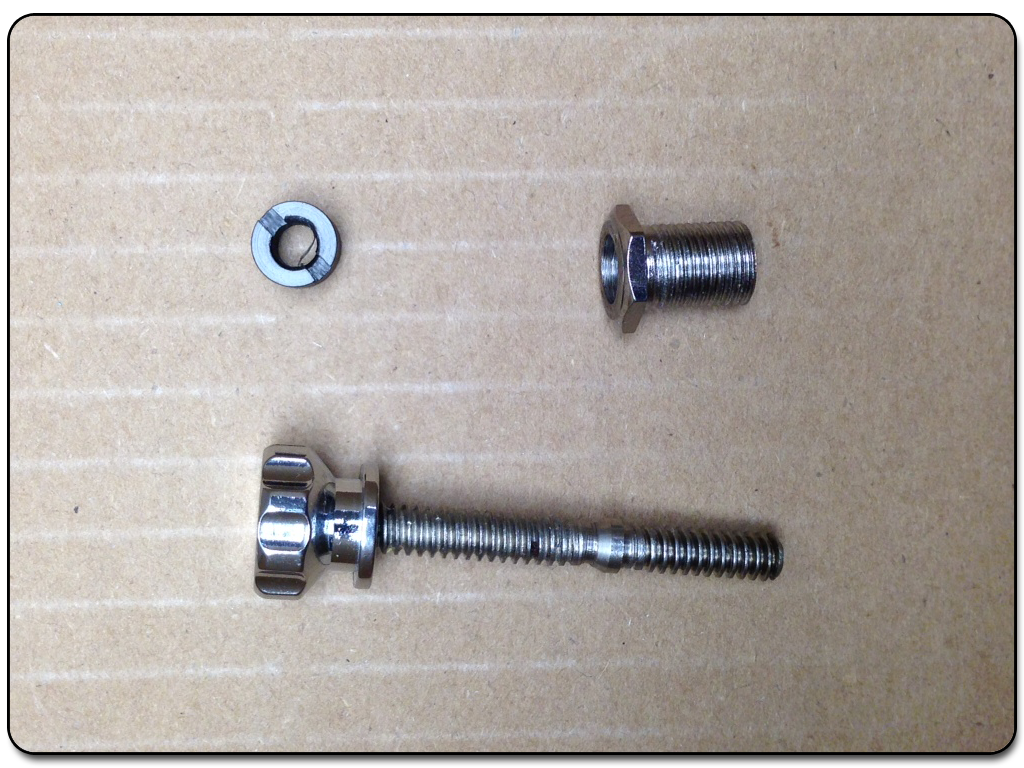
First, here is an explanation of the parts of the thumbscrew (the male half) that are inside of the neck heel.

Barrel Wrench-1

  • Thumbscrew Retainer Grommet (This is what you adjust with the barrel wrench, pictured top-left.)
  • Sleeve (pictured top-right)
  • Thumbscrew (pictured bottom)

Barrel Wrench-2

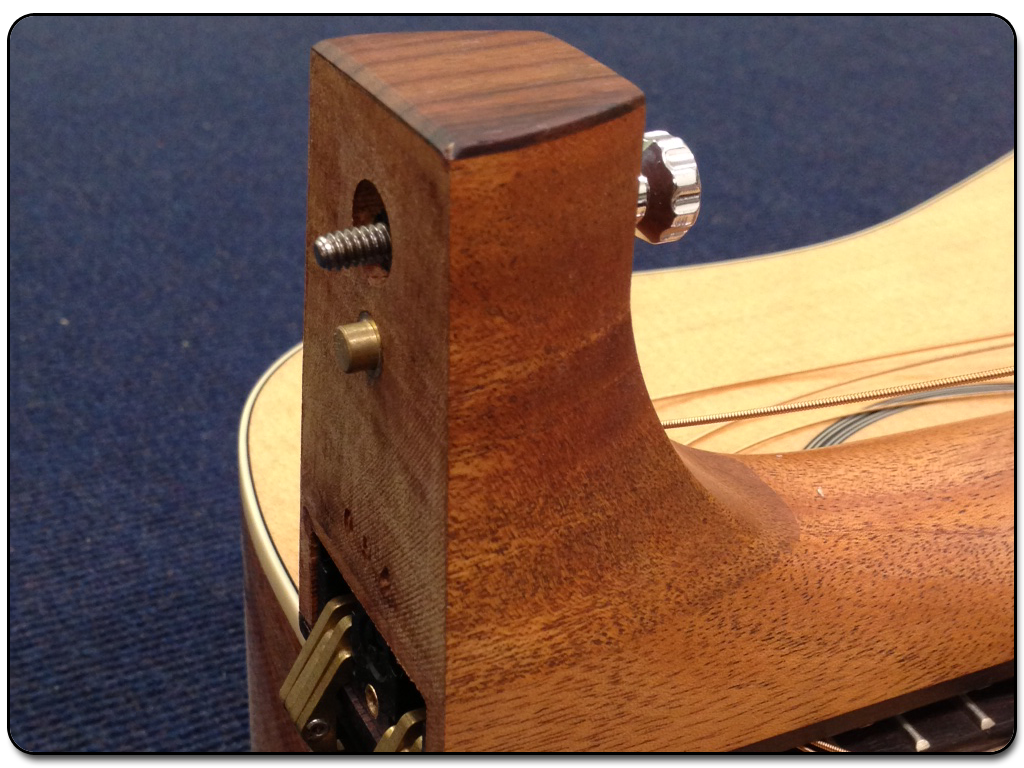
  • Now, here is an example of a thumbscrew grommet that has been shifted or shimmied into an incorrect position.
  • INCORRECT: Thumbscrew is all the way in and grommet is visible.
  • [A Visible Grommet is incorrect]

Barrel Wrench-3

  • To correct this issue.
  • Place the guitar on a solid, non-scratch surface. Make sure that the Voyage Air Guitar is in the folded position and the thumbscrew grommet is visible and accessible.

Barrel Wrench-4

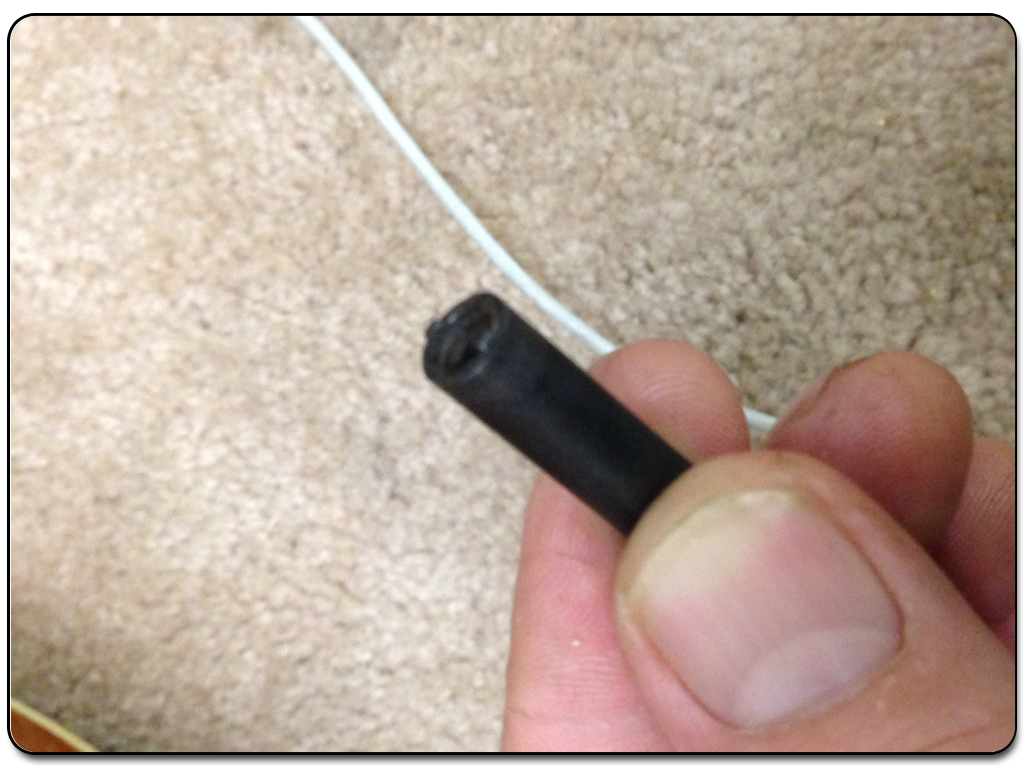
  • Connect the end of the barrel wrench to the grommet protruding from the thumbscrew.
  • [Connect Barrel Wrench to Grommet]

Barrel Wrench-5

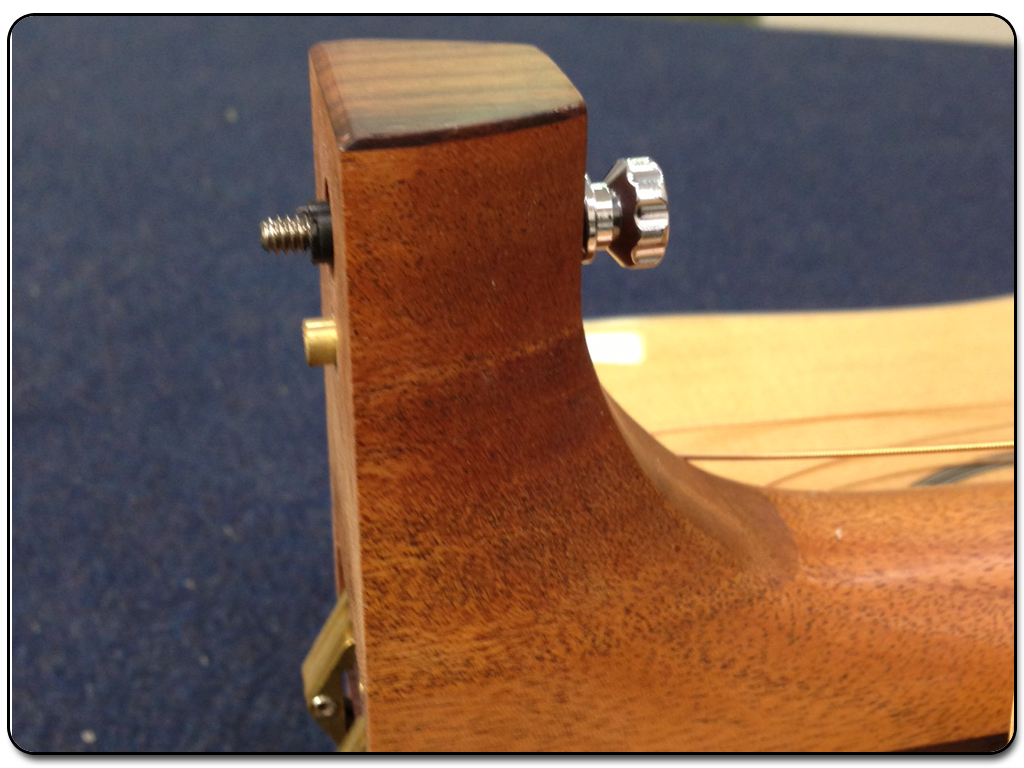
  • Rotate the thumbscrew clockwise until the grommet is no longer visible.
  • CORRECT: Thumbscrew is all the way down and the grommet is NOT visible
  • Click here for a printable pdf