The Proper Care of your Voyage-Air
At Voyage-Air Guitar, we want you to get the best sound and longest life from our fine instruments. This section has tips and suggestions to help you achieve that goal. If you have questions that aren’t covered in these sections, please check frequently asked questions about Voyage-Air Guitars. If you are still in need of information, then contact us at info@voyageairguitar.com. Printable Voyage-Air Guitar Owner’s Manual (pdf download) (online viewer).

Truss Rod Adjustment

How To Adjust The Neck Of Your Voyage Air Guitar With Adjustable Truss Rod

All Voyage Air Guitars are equipped with adjustable truss rods. The purpose of a truss rod is to adjust the neck to counteract string tension. The reasons for truss rod adjustments vary and this both strengthens the neck and allows for adjustments of bowed or warped necks. Common reasons for this effect are climatic changes and changing the string gauge or tuning pitch. String tension changes can affect string height, also known as the action.

To adjust the truss rod, remove truss rod cover located on the headstock.

Neck BOW Neck HUMP

Sight DOWN the neck from the headstock in order to properly gauge the bow (pictured left above) or hump (pictured right above) of the neck.
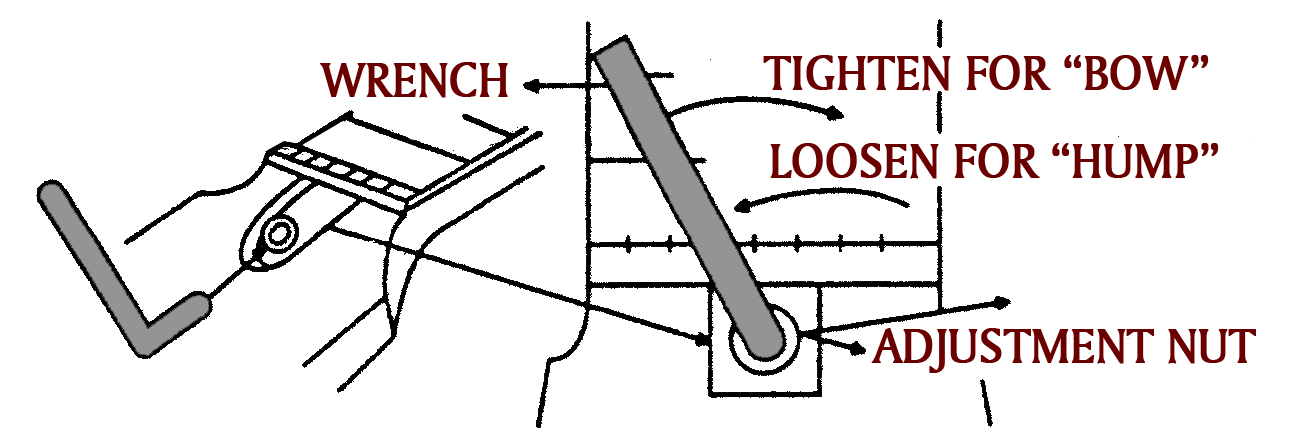
Truss Road Adjustment Diagram

Insert supplied Allen wrench (size: 5/32nds). If bowed, begin tightening (clockwise) or, if the neck has a hump, begin loosening (counterclockwise) the rod. Turn very gently at small increments and continue to check the neck as you proceed with each fraction of a turn.

String height to obtain when adjusting the truss rod

Truss rod tension can also be measured by installing a capo on the first fret and holding the string at the fret where the neck joins the body. Insert a thickness gauge between the string and fret at the 8th fret. There should be about .010 clearance (app .254mm). This clearance is called “neck relief”. If there is too little neck relief, there will be fret buzzing, and too much relief can cause poor intonation and a high action. If buzzing continues after the neck is straightened, additional fret lowering or filing may be required.

Printable pdf version click here.
String Tension

In most cases, the string tension is NOT released before loosening the strap button bolt and folding a Voyage Air Guitar. To ensure your safety, pay careful attention to the correct procedure for unfolding and folding your Voyage Air Guitar. We strongly recommend that you watch the demonstration on our HOW IT WORKS page. Also, please read the instructions provided with the instrument before you unfold and fold the guitar for the first time. There is a tendency for the guitar neck to spring outwards after the bolt is loosened, and this is perfectly normal. Be aware, and be prepared for this spring effect: it’s the key to safe and proper folding/unfolding and storage of your guitar.

Related to String Tension is the relief (bow) or reverse curve (back-bow) of the guitar fingerboard. Every Voyage Air Guitar is equipped with an adjustable truss rod installed within the neck. This truss rod can be adjusted from the peghead using the wrench provided with each guitar.

For optimum playing performance, we suggest that you let the guitar acclimate to the environment (temperature and humidity) in which it will be played. (NOTE, all Voyage Air instruments are set-up and played prior to shipping. However, different climates and environmental conditions may affect the guitars playability. A second look and personal adjustment in your specific environment will insure the best performance from the instrument.)

After you’re completely satisfied with the playability of your Voyage Air Guitar, we recommend that you leave it unfolded, with the guitar neck locked in the playing position. This allows your instrument to ‘settle in.’ While in the playing position, the string tension on the neck will create the necessary relief (bow). When the neck is folded, the string tension will be released.

All Voyage Air Guitars are designed to be folded and unfolded as many times as your traveling needs require. There is no danger in folding and unfolding it constantly. However, removing tension from the neck may require some time for the neck relief to come back into the neck once in the playing position.

Instructions for Unpacking

Thank you for choosing a Voyage Air Guitar. We know that the ability to travel with your guitar will inspire you to practice, play and share your music with others for many years to come. Now, get ready to enjoy the feeling. Play. Fold. Travel. Repeat.

Follow these simple steps to make your Voyage Air Guitar ready for play:

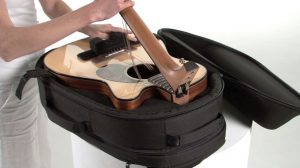
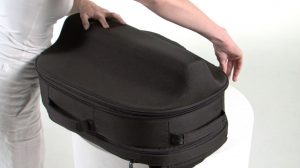
The Voyage Air Guitar is shipped inside a durable backpack-style case. Set this case on a stable surface (like a table) with the flat side down.
Unzip and open the case. Do not remove the guitar just yet.
The neck of the guitar has a hinge. Lift the neck up and away from the guitar.
The body of the guitar is secured in the case with a black nylon strap (the one with the pad for the neck). Undo this strap while holding the neck of the guitar.
Lift the guitar by the neck so the body of the guitar is nearly vertical. Keep the bottom of the guitar resting in the case.
Place your palm on the back of the guitar, near the top of the guitar body, but below the neck hinge.
With both hands, position the guitar slightly so the sound hole is pointing down towards the table surface.
Being careful that your hands or fingers are not in the way as the hinge closes. Pull the neck of the guitar into the playing position.
Tighten the hinge-locking thumbscrew to secure the guitar in the playing position. Just use your fingers to make the thumbscrew tight: no tools are necessary. Note: this thumbscrew also serves as the guitar’s strap-button.
Tune the guitar. Play and enjoy.
To fold and store the guitar in the backpack case, reverse the steps listed above.

Printable Voyage Air Guitar Owner’s Manual (pdf download)

IMPORTANT! Please read these step-by-step instructions carefully before you attempt to assemble and start playing your new Voyage-Air Guitar! Personal injury and damage to your guitar can result if it is not handled properly.